TL;DR. If you need one strong resume and the tool is genuinely free, you do not need to pay. Pay when you are running an active search across multiple roles or rewriting bullets with AI at scale. Three category behaviours hide the real cost of "free" builders: watermarks on free exports, low-price trials that renew at full price unless you cancel, and download caps. The price table below lists what seven builders charge monthly, quarterly and annually, each checked on the vendor's own pricing page on 29 September 2026. SimpleCVBuilder Pro is $12.99 a month or $79 a year (£9.99 or £59 in the UK), and one resume stays free with no watermark and no credit card.
Last updated: 29 September 2026. Prices checked on 29 September 2026.
Do you actually need to pay for a resume builder?
The honest answer is it depends, and here is when. For a single focused job search (one role, one or two tailored PDFs, a handful of applications) a well-built free tier is enough. You need templates that parse cleanly through an applicant tracking system, a PDF export with no watermark, and ideally an ATS check so you can verify the file before sending. That is a solved problem, and several tools give it away.
Paying becomes rational when the maths shifts. US median employee tenure fell to 3.9 years in January 2024, per the Bureau of Labor Statistics (the lowest since 2002), and 51% of organisations now use AI in recruiting, up from 26% in 2024 per SHRM's 2025 Talent Trends. Most workers will rewrite their resume several times across a career, and recruiters increasingly screen with AI that rewards specific, quantified bullets. When you are running an active, multi-role search against that backdrop, a paid tier with bullet rewriting, skills translation, and unlimited tailored versions starts paying for itself in hours saved, not dollars spent.
What a genuinely-free resume builder gives you
Before judging whether paid is worth it, it helps to know what reasonable "free" actually looks like in 2026. A genuinely-free resume builder, not a free-trial product wearing a free label, should give you:
- A working editor. Real-time preview, drag-and-drop sections, grammar-aware text fields.
- A handful of templates that cover both modern and traditional ATS layouts. A few good ones are plenty for most job seekers; thirty is marketing.
- PDF export with no watermark. The file you download is the file you send. A "Made with X" footer is not acceptable in a genuinely-free tier. Recruiters notice.
- Basic ATS compatibility. Single-column layouts, standard headings, a parseable text layer. The Harvard Business School and Accenture "Hidden Workers" study estimated 27 million US workers are excluded because their resumes do not match rigid ATS criteria, so this is not a nice-to-have.
- No credit card required to reach a download button. If you need to enter a card before you can export a file, it is a free trial, not a free tier.
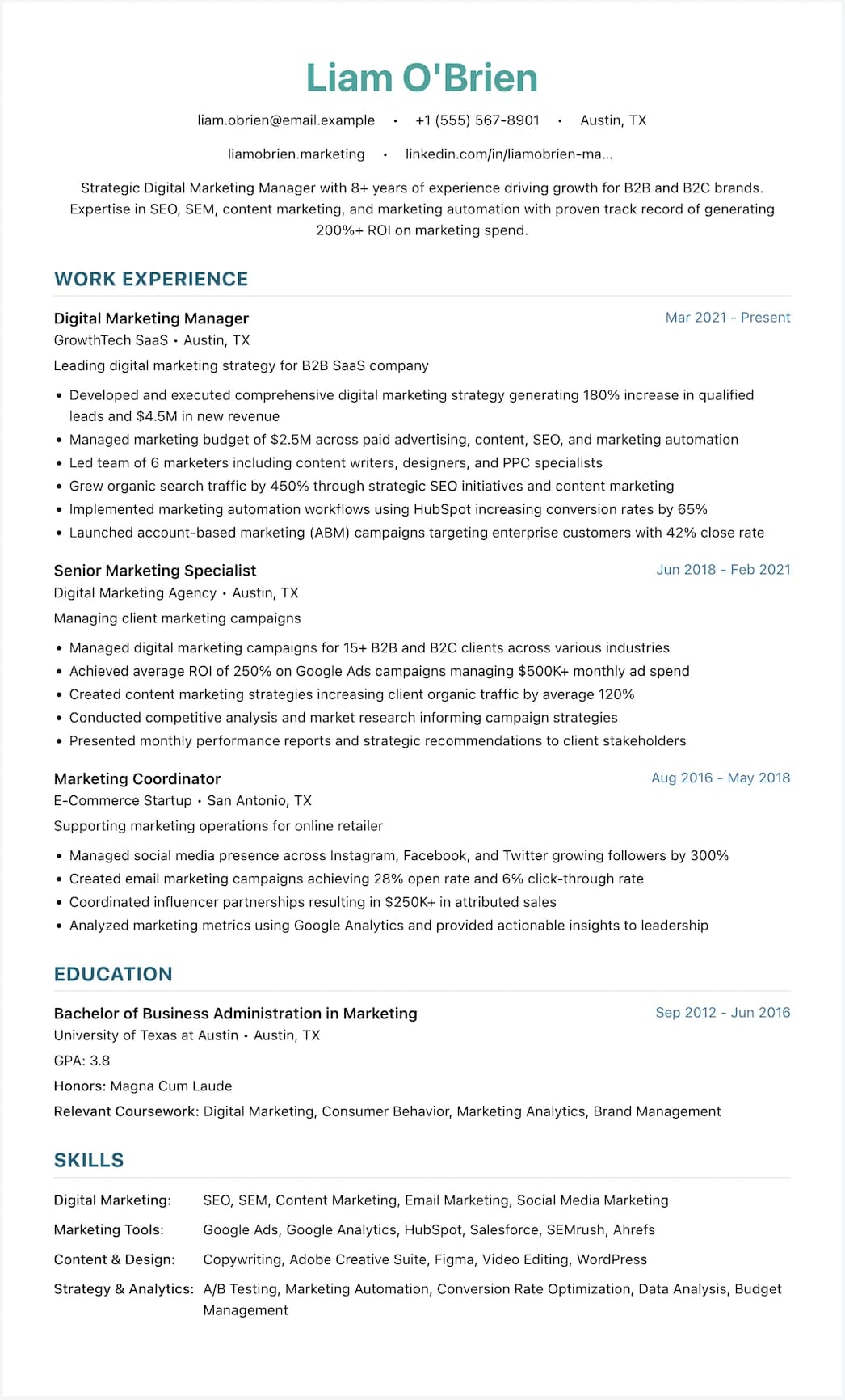
That is the baseline. SimpleCVBuilder's free tier sits here: one resume, 3 of our 12 templates, an AI ATS analyser and a watermark-free PDF (one free download per resume). For most single-role job seekers, that is enough.
Where free becomes limiting
The moment your search scales, the cracks show. Three situations where a free tier genuinely starts to cost you time:
Multiple tailored resumes for an active search. A typical professional job search involves applying to ten to twenty roles across overlapping but distinct skill profiles: a senior IC role in one tab, an adjacent staff-level role in another, a people-manager pivot in a third. Each deserves its own resume. Most free tiers cap you at one saved file. That means re-editing the same document, exporting, and losing the version history every time you tailor.
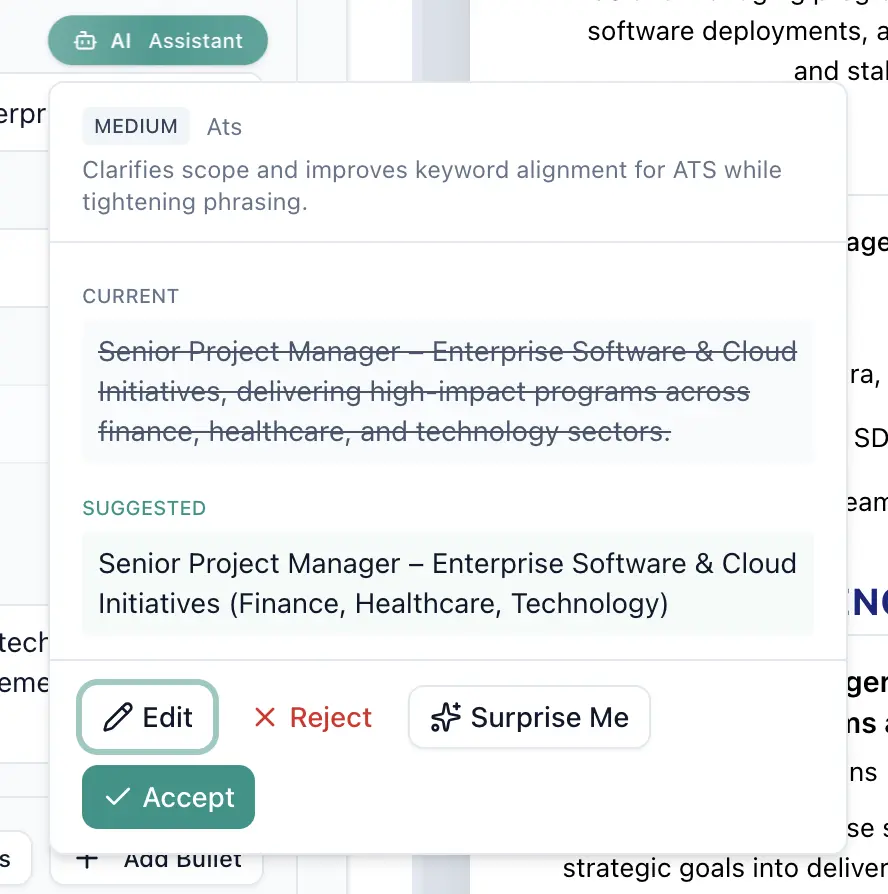
Advanced AI — bullet rewriting, skills translation, job matching. Free ATS scoring is table stakes now. Advanced AI is not. A bullet generator that rewrites "managed classroom of 30 students" into "led 30-person stakeholder group through 9-month curriculum rollout, delivering on time and under budget" saves hours on a career pivot. A skills translator that maps a teacher's experience to a project manager's language is the difference between a viable application and an ignored one. Gartner reports that 82% of HR leaders plan to deploy agentic AI within 12 months, so AI-readable bullets matter more, not less.
CV parsing — uploading an existing PDF into a new template. If you already have a resume, pasting it into a new format by hand is painful. Paid tiers typically include a parser that ingests the file, extracts structured fields, and drops them into your chosen template. Most free tiers skip it because running a parser is expensive.
The hidden-cost patterns in paid resume builders
This is the section most "free vs paid" articles dodge, because most "free vs paid" articles are written by paid resume builders. These are category behaviours: industry-wide patterns you should recognise regardless of which builder you pick.
- Watermark-on-free-tier. The builder is free to use, but the exported PDF carries a visible "Made with X" line across the footer. Removing it requires upgrading. The practical effect: the free tier is a demo, not a working tool.
- Trial-to-paid flip. A low-price entry point, often $2.95 for two weeks, that auto-renews at roughly $24.95 per month unless the user opts out. Legal. Common. Easy to miss on day 15.
- Single-resume download limits. Some free tiers let you build unlimited resumes but only export one per billing period. You hit the cap at the worst possible moment, the day before a deadline.
- "Free" that locks the PDF behind signup-then-paid. The editor is free; the download is not. You reach the export button and the paywall appears. Common enough that "free resume builder, actually free" is a search query with real volume.
- Template-lock. The free tier limits you to two or three basic templates. Any visually distinctive design sits behind Pro, which tempts you to pay for aesthetics even when you do not need the AI.
None of these patterns are unique to any single builder. They are the industry's default monetisation toolkit. Which is why the question is not "free or paid" but "is this tier honest about its tier, and does the paid upgrade solve a problem I actually have?"
When free is enough — the decision rubric
Stay on the free tier if most of these describe your situation:
- You are applying to five or fewer roles per month.
- You have one career direction — no major pivot, no multi-industry split.
- You need PDF output only, not TXT for pasted online forms.
- You are early in the search and do not yet know your target well enough to warrant tailored versions.
- You have a decent first draft already and do not need AI bullet rewriting.
If four out of five are true, a genuinely-free tool is enough. One resume, one PDF, one good recruiter-ready file. Done.
When paid is worth it — the decision rubric
Upgrade when most of these describe your situation:
- You are applying to ten or more roles per month with tailored versions.
- You are pivoting careers and need AI to translate transferable skills into the new industry's language.
- You are a freelancer who maintains multiple client-facing CVs — one for design clients, one for consulting, one for full-time recruiters.
- You are an international student applying across US, UK, and EU markets where resume conventions differ.
- You want TXT or DOCX exports for job boards that strip PDF formatting.
- You have an existing resume in a competitor's format and want to re-template without retyping.
A career changer with a deep pivot usually saves more than the $12.99 Pro price in a single week of AI-assisted bullet rewriting. An international student applying to three domestic employers is fine on the free tier.
What paid resume builders cost in 2026
Prices checked on 29 September 2026, each on the builder's own pricing page (linked). Pages show prices in the visitor's currency, so the currency below is the one each page displayed when we checked; the amount in your country may differ. "Not stated" means the page did not list that billing period. Zety is left out because its pricing page did not load for us on that date.
| Builder | Free tier | Trial | Monthly | Quarterly | Annual |
|---|---|---|---|---|---|
| Resume.io | One resume, TXT download only | £2.95 for 7 days, then £19.95 every 4 weeks | Not stated (4-weekly) | £49.95 every 3 months | Not stated |
| Resume Genius | TXT download only | $2.95 for 14 days, then $23.95 every four weeks | Not stated (4-weekly) | Not stated | $95.40 a year |
| Kickresume | Free plan, "unlimited downloads" | Not stated | €24 a month | €54 every 3 months | €96 a year |
| Enhancv | 7-day free plan with Enhancv branding | 7-day free plan | $39 a month | $69 every 3 months | Not stated ($99 every 6 months) |
| Novorésumé | Basic plan; downloads with Premium features not allowed | Not stated | £21.99, one-off | £49.99, one-off | £189.99, one-off |
| FlowCV | One resume, unlimited PDF downloads, no watermark | Not stated | Not stated | Not stated | $60 a year |
| Canva | Free plan (resume watermark rules not stated) | Free trial, length not stated | Not stated | Not stated | $144 a year (Pro, one person) |
| SimpleCVBuilder | One resume, 3 of 12 templates, one free PDF per resume, no watermark | 7 days of Pro, renews at the normal monthly price | $12.99 (£9.99) a month | Not offered | $79 (£59) a year |
Notes from the pages themselves: Enhancv's visible price card failed to render on the day, so its figures come from the pricing data embedded in the same page; Novorésumé says its plans are "Pay once. No recurring billing." and that tax "may vary by location". Check the renewal line on any checkout page before you pay; that is where the four-weekly billing shows.
Honest side-by-side: what a good free tier looks like
| Feature | Minimum bar for a "genuinely free" tier | SimpleCVBuilder free | Common industry pattern |
|---|---|---|---|
| Watermark on free PDF | None | None | Often present, "Made with X" footer |
| Credit card to export | Not required | Not required | Sometimes required for "free trial" |
| Trial-to-paid flip | None | None | Common: $2.95 or £2.95, then full price every 4 weeks |
| AI ATS analyzer | Included | Included (rate-limited) | Often Pro-only |
| Templates on free | A few ATS-safe layouts | 3 of 12 | Varies |
| Resumes saved on free | 1+ | 1 | 1 or unlimited-build-with-paywalled-export |
| Data privacy (GDPR) | Clear policy, no data sale | Yes, on by default | Varies |
Feature patterns change often; the prices are in the dated table above. The checkout page on any given builder is the only source of truth. Open a private window, go to the download step, and the truth will reveal itself.
See exactly what free and Pro include
Transparent feature-by-feature breakdown of the free and Pro tiers. No buried trial flips, no surprise renewals.
SimpleCVBuilder's honest answer
We are the paid option in this comparison, so here is a direct statement rather than a pitch.
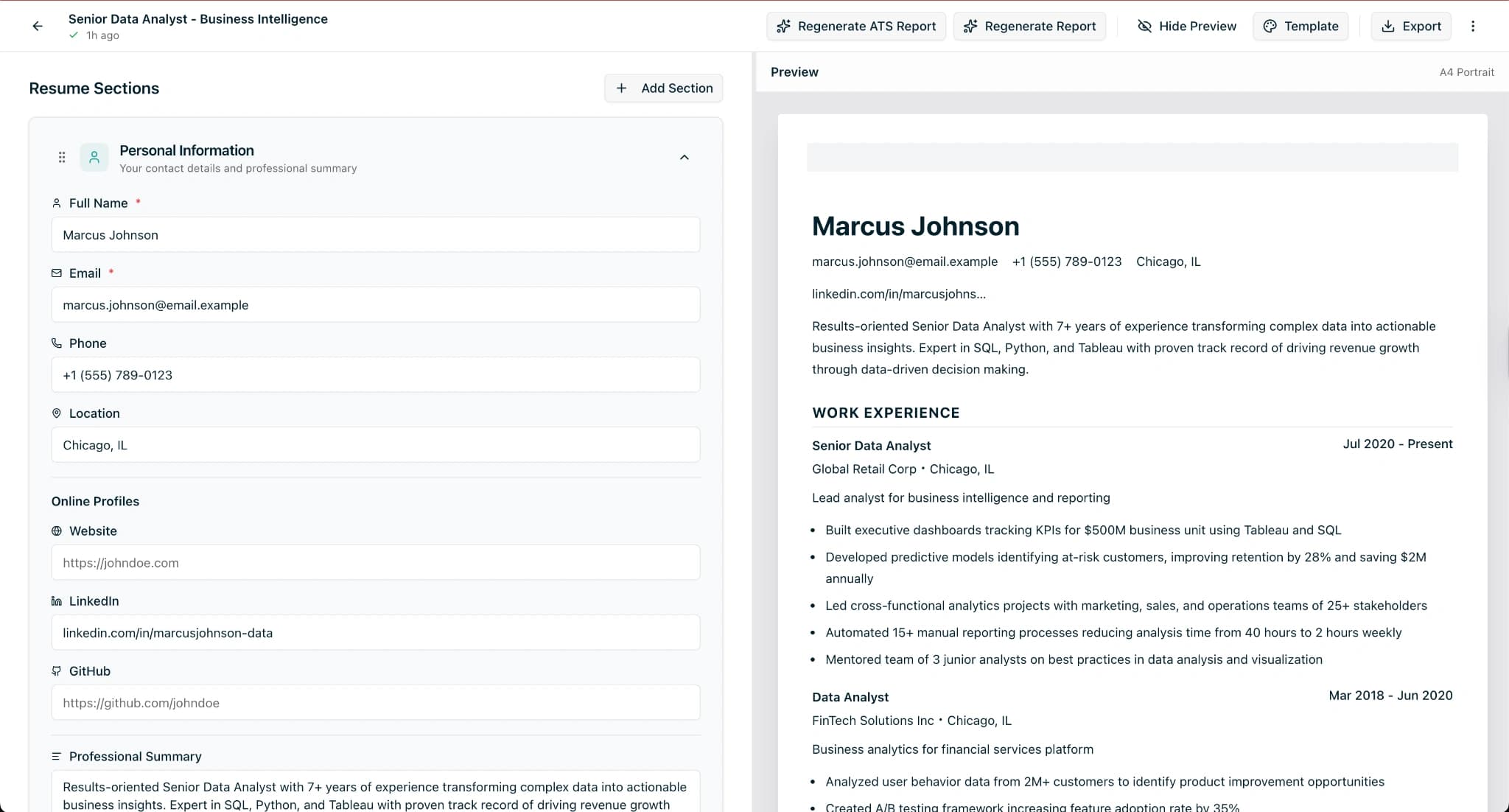
Free tier. One resume saved. 3 of our 12 templates (Modern, International Student and Education). AI ATS analyser included. One free PDF download per resume, with no watermark. No credit card to sign up. Private by default under GDPR: your data is never sold.
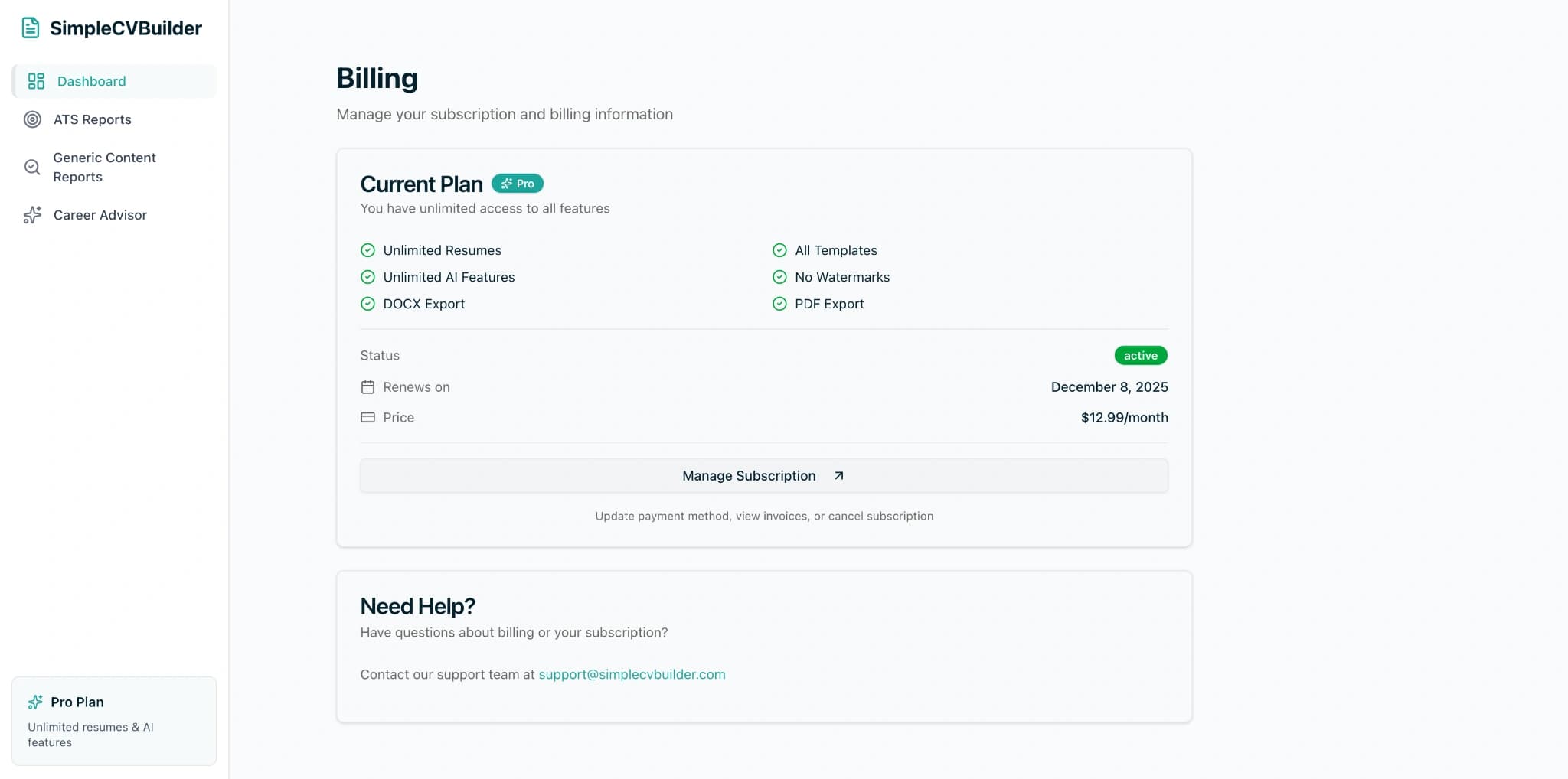
Pro tier: $12.99 a month or $79 a year (£9.99 or £59 in the UK). Unlimited resumes, all 12 templates, the full AI toolkit (bullet generator, Career Advisor, tailoring to a job ad), TXT and Word exports, and advanced template customisation. No cheap trial that jumps in price: the price you see is the price that renews. Monthly plans cancel any time from Billing.
The design trade-off is explicit: we keep Pro's price low, and we make the free tier useful rather than a demo, so most single-role job seekers can stay on it without friction. Honestly, we would rather you stay free and tell a colleague than upgrade reluctantly and churn two weeks later.
If you want to see how the free tier behaves before comparing, start a resume. The download button works, and the PDF has no watermark. If you get there and decide you need more, Pro is one click away. If you decide the free tier is enough, that is a legitimate outcome too.
A word on comparison fatigue
Most "best resume builder" content online is written either by paid builders or by affiliate sites earning a commission per signup. Neither is neutral. A useful way to cut through: ignore the rankings, run the builder to the download step yourself, and check three things. Is the PDF watermarked, is a card required, and can you cancel without friction. The checkout page answers more honestly than any review.
If the jargon is getting in the way, our free CV builder guide covers what "free" really means across the category, and our free resume builder comparison does the same with US-market framing. For builder-independent advice on keeping your resume ATS-readable, see the ATS guide. The rules apply regardless of which tool you use.
Start free: no watermark, no credit card
One resume, 3 templates, AI ATS scoring and a clean PDF download. Upgrade only when you actually need more.
Frequently asked questions
Do I actually need to pay for a resume builder in 2026?
Not for most single-role job searches. If you need one strong resume, export it as a PDF once or twice, and are not running AI features at scale, a genuinely free tier is enough. Paying is worth it when you need several tailored resumes for an active search or advanced AI such as a bullet generator or skills translator.
Is the SimpleCVBuilder free tier really free?
Yes. One resume, 3 of the 12 templates, an AI ATS analyser and a PDF download with no watermark: one free PDF per resume, then $3.99 a download or unlimited on Pro. No credit card is needed. If you need several tailored versions, that is when Pro becomes useful.
What is the typical price of a paid resume builder?
It depends on how the builder bills. On 29 September 2026 the pricing pages we checked listed Resume.io at £2.95 for 7 days, then £19.95 every 4 weeks; Resume Genius at $2.95 for 14 days, then $23.95 every four weeks; Kickresume at €24 a month or €96 a year; and FlowCV at $60 a year. The price table in this post links each source. SimpleCVBuilder Pro is $12.99 a month or $79 a year.
What is the trial-to-paid flip, and how do I avoid it?
It is the pattern of a low-price introductory trial, often $2.95 or £2.95 for 7 to 14 days, that renews automatically every four weeks at the full price unless you cancel. It is legal, but easy to miss. Before entering a card, confirm the renewal price, the renewal date and how to cancel. If any of those answers are buried, treat the product as paid from day one.
When is a paid resume builder genuinely worth it?
Four profiles benefit most: active multi-role job seekers applying to ten or more roles with tailored versions; career changers who need AI to translate transferable skills; freelancers juggling multiple client-facing CVs; and international students applying across different country formats. Outside these, the free tier of a well-built tool is usually enough.
Do free resume builders produce ATS-friendly PDFs?
Some do, some do not. An ATS-friendly resume uses a single-column layout, standard headings, and a parseable text layer. Many free exports are image-based PDFs or multi-column designs that Workday, Greenhouse, Lever, and Taleo misread. The test is simple: copy the text out of the PDF into a plain text editor. If it comes out garbled, the ATS will struggle.
Is SimpleCVBuilder GDPR compliant?
Yes. Resume data is stored with row-level security, data is never sold, and users can export or delete everything from account settings. The free tier requires no credit card, so no billing data is collected unless you upgrade. Privacy is on by default, not opt-in.
Can I cancel a paid resume builder after one month?
On most platforms, yes: subscriptions are month-to-month and cancellable from settings. Read the cancellation policy before signing up: some require cancellation a full billing cycle in advance, and refunds for partial months are rare. SimpleCVBuilder Pro is month-to-month with no cancellation fee.