
An ATS CV checker shows you what an applicant tracking system is likely to pull out of your CV before a recruiter sees it. Ours is free, needs no sign-up and returns a score out of 100 with the three fixes worth doing first, usually in under 30 seconds. Here is what the score means and what to do next.
How UK ATS systems read your CV
An applicant tracking system is the software an employer uses to collect and search job applications. When you upload a CV, it usually converts the file to text and tries to sort that text into fields such as name, contact details, job titles, employers, dates and skills. If a detail never lands in a field, a search for it will not find you.
This step is called parsing, and it is where things go wrong. One system, Greenhouse, tells candidates that parsing "can make mistakes" and asks them to check the result before they submit.1
UK conventions help here. Prospects, the UK graduate careers site, recommends a CV of no more than two A4 pages and no photo unless you are applying for acting or modelling work.2 The National Careers Service says to leave out your age, date of birth, marital status and nationality.3 Fewer extras means less for a parser to trip over. Many public-sector roles go through their own services, such as NHS Jobs4 and Civil Service Jobs,5 so follow the advert: if it asks for a form, the form is what gets read.
What the ATS score measures
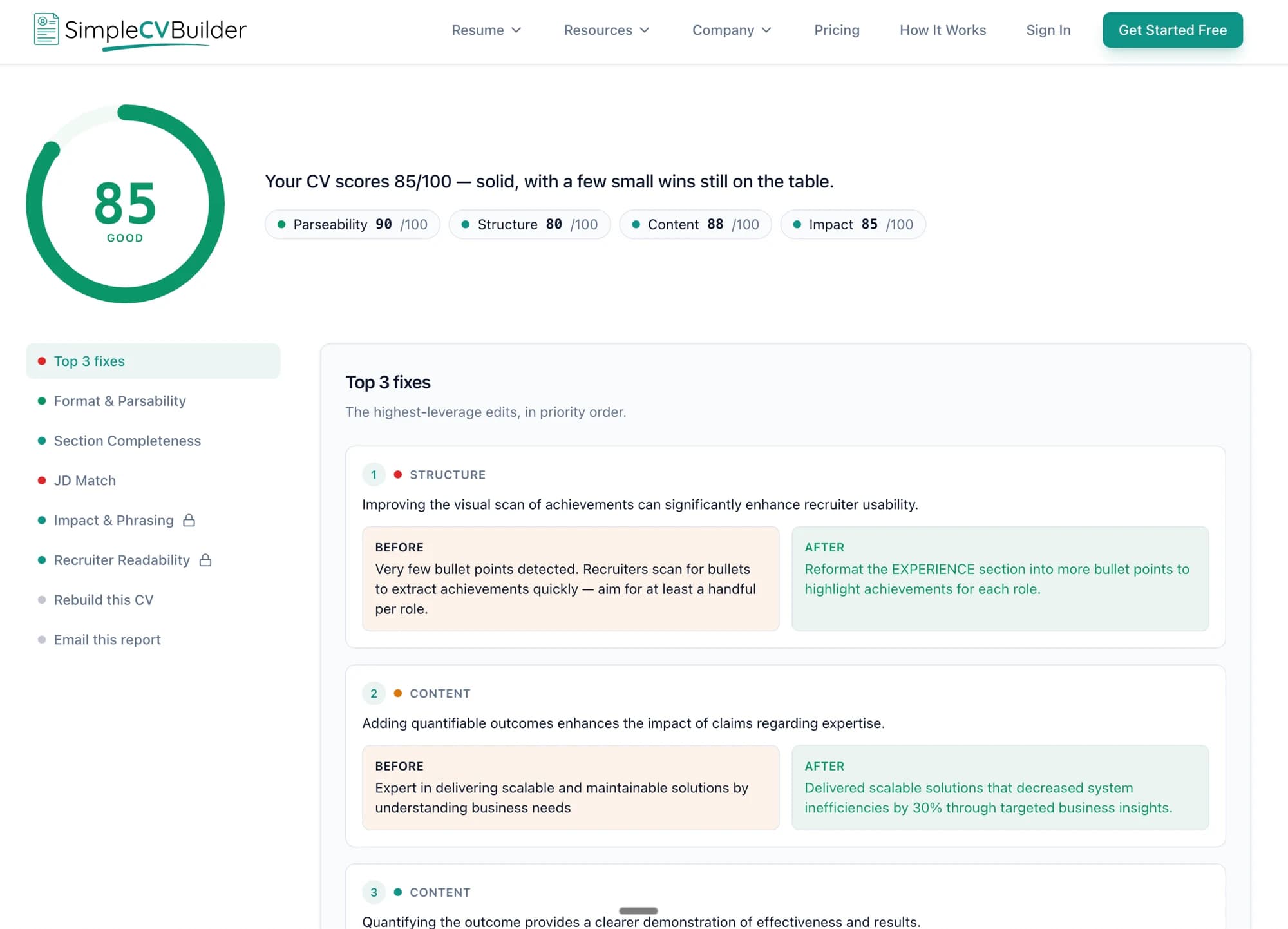
Your score is out of 100. It is a weighted average of four sub-scores, the same four chips you see at the top of your report: content counts for about 35%, parseability 25%, and structure and impact 20% each. We band the results as excellent (90 and above), good (75 to 89), needs work (50 to 74) and critical (below 50). If you paste in a job advert, you also get a separate keyword match score.
Parseability
This part is rule-based, with no AI involved. We check that the file has real, selectable text, whether it is a scan, how many columns it uses, and whether an email address and phone number can be found. If the file is a scan or scores below 50 here, we stop and report parseability alone, because grading text an ATS cannot read would be guesswork.
Structure
Structure checks that the sections a recruiter expects are there and named so a parser recognises them: a summary, experience, education and skills. It also looks at page count and at how much of your experience is written as bullet points rather than long paragraphs.
Content
Content is graded by AI against a fixed rubric, with worked examples of strong and weak bullet points. It looks at the verbs you open with, how many achievements carry a number, passive phrasing such as "responsible for", and generic claims. Any criticism has to quote a line from your CV.
Impact
Impact asks what changed because you were there. It looks for evidence of leadership and ownership, and at the level of seniority your CV signals. A CV can be perfectly readable and still score low here if every line lists duties rather than results.
The five ATS failures we check for first on UK CVs
Two-column layouts
Sidebars look tidy, but a parser can read across the page instead of down each column, so sidebar skills can end up stitched into a job title. Greenhouse lists columned layouts as a cause of failed parses.6 Our checker counts the columns in a PDF and flags anything over one. The fix is a single column, with skills in a section of their own.
Contact details in headers
It is tempting to put your name, email and phone number in the page header. Some parsers miss headers and footers, which can leave a recruiter with no way to reach you. Greenhouse lists contact details in a header, footer or text box as a known problem.6 Put them in the body of the first page as plain text.
Scanned PDFs
A scanned CV, or a PDF made from a photo, is a picture of text rather than text. A parser that cannot read images gets nothing from it, and Greenhouse lists image uploads among the causes of failed parses.6 Export a fresh PDF from Word or Google Docs, or upload the .docx file itself.
Non-standard section names
"My journey", "What I bring" and "Toolkit" read well to a person and badly to a parser looking for Experience, Education and Skills. Greenhouse lists unclear sections as a parsing problem too.6 Keep the personality for your personal profile and use plain headings for the sections themselves.
Missing role keywords
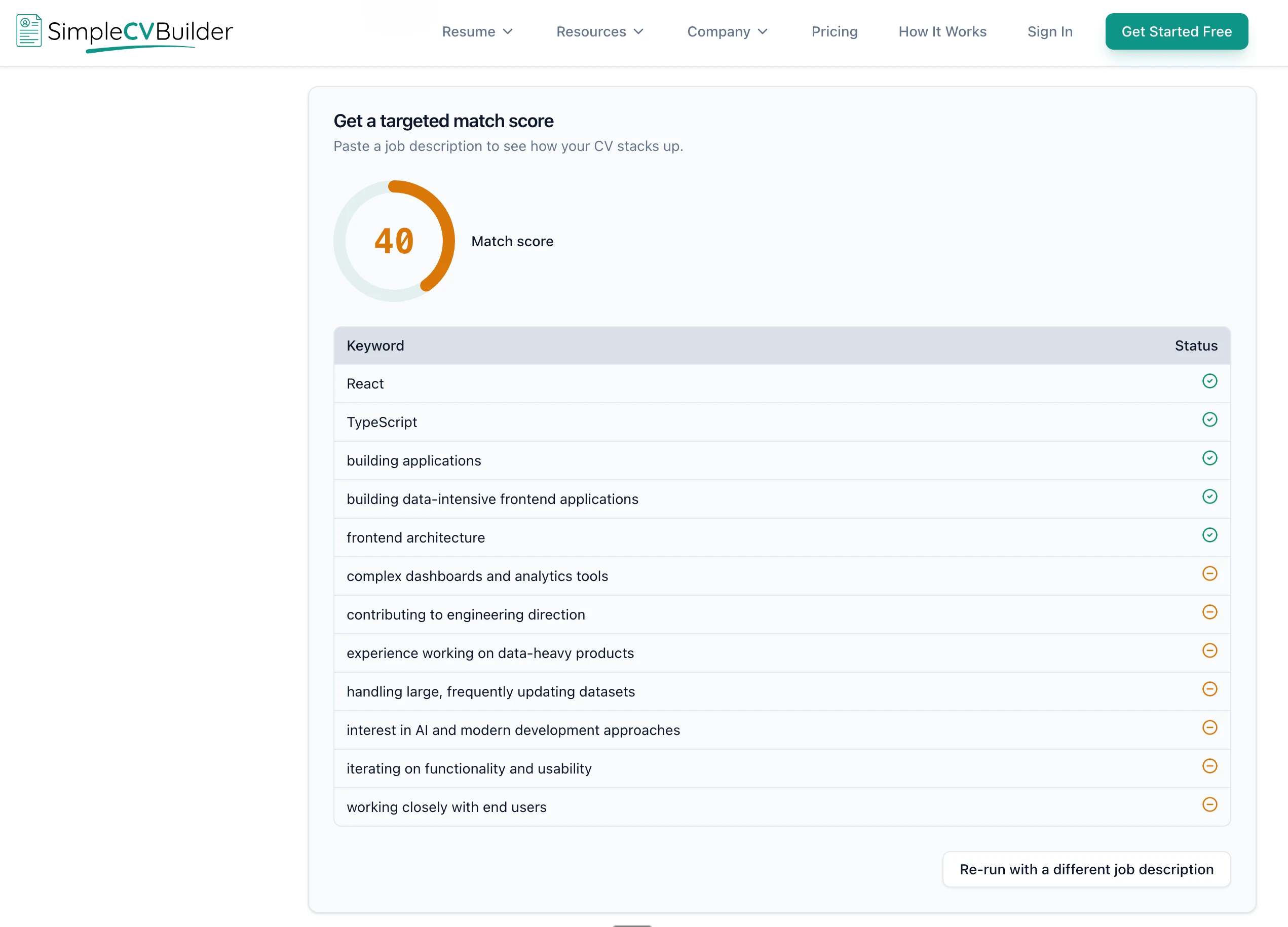
Recruiters often search parsed CVs for the skills and job titles in the advert. If the advert says "stakeholder management" and your CV only says "worked with senior teams", that search will pass you by. Paste the job advert into the checker and it counts how many of its keywords your CV covers and how many are missing. The list itself comes with a free account. Only add ones you can back up.
ATS CV checker or CV scanner: what is the difference
Very little. The two names describe the same kind of tool: something that reads your file the way a tracking system would and reports what it found. Neither is the employer's ATS, so treat the result as a rehearsal. What matters is what a tool checks. Ours starts with whether the text can be read at all, then grades structure, content and impact, and adds keyword matching when you give it a job advert.
What to do after your free ATS CV check
Start with the three fixes at the top of your report. They are ranked by how much they should lift your score.
- Read our ATS guide for the reasoning behind each rule and a checklist to work through.
- If the layout is the problem, choose one of our CV templates. Ten of the 12 are single column.
- Create a free account to see the full fix list and keyword gaps. Sign up from your report and your CV opens in the builder, already filled in.
- Applying for a particular job? Tailor your CV to it: paste the advert to see your match score before and after, plus the missing keywords. Free accounts get three runs a day.
Then run the check again: you get three uploads an hour.