TL;DR. A freelancer resume is not a portfolio, and it is not a watered-down full-time resume. It is a project-case-study document that frames independent work as structured, outcome-driven experience. Group engagements under one header like "Independent Consultant, 2022 – present", then list three to six projects with a consistent block: Client or Industry, Role, Duration, Tools, Outcome. Put a number on every outcome. Handle gaps honestly, skip rates, and use the portfolio for depth.
April 2026.
Freelancers ask two versions of the same question. The first: "How do I write a resume when I have never had a single employer?" The second: "How do I write a resume when I already have a portfolio site?" Both have the same answer. Structure your work as projects, attach an outcome to each, and let the resume do the job the portfolio cannot. A portfolio shows craft to people already paying attention. A resume wins the first thirty seconds with recruiters, ATS systems, and referral intros who are not.
Freelance work is not a hedge anymore. Full-time US independents grew from 13.6 million in 2020 to 27.7 million in 2024, per MBO Partners, with 5.6 million earning more than $100,000 annually in 2025. US knowledge freelancers earned roughly $1.5 trillion in 2024, per Upwork's Future Workforce Index. In the UK, IPSE's Self-Employed Landscape 2024 counted 2.046 million freelancers contributing £366 billion to the economy. The category is mainstream; the resume format mostly has not caught up.
Why freelancer resumes are different
Three structural differences separate a freelancer resume from a traditional one, and ignoring any of them is the most common way the document reads as weaker than it should.
Concurrent engagements replace single-employer tenure. A full-time resume assumes one company at a time, with clean start and end dates. A freelancer often has three clients running in parallel, two on retainer and one on a fixed deliverable. Listing each as a separate job produces a resume that looks cluttered, repetitive, and shallow, the same responsibilities restated under different logos. Grouping them under a single header ("Independent Consultant", "Freelance Product Designer", "Contract Data Engineer") with project blocks underneath reads cleaner and signals intention rather than churn.
Outcomes replace job descriptions. A full-time resume can lean on the assumption that "Senior Engineer at Stripe" carries shared meaning. A freelancer has no logo shorthand. The reader has never heard of most of your clients and cannot infer scope. What you did, what changed, and what it was worth have to sit inside the bullets themselves. This is why the single highest-leverage change a freelancer can make is rewriting every bullet to end in a number.
Strategic breaks replace continuous employment. Freelance careers have rhythm: a heavy quarter, a three-month research break, a maternity cover, a one-month certification push. On a traditional resume these look like gaps. On a freelancer resume, labelled honestly, they look like directed work. BLS data shows US median employee tenure fell to 3.9 years in January 2024, the lowest since 2002, so non-linear careers are now closer to the norm than the exception. Recruiters read them better than they used to.
The project-case-study structure
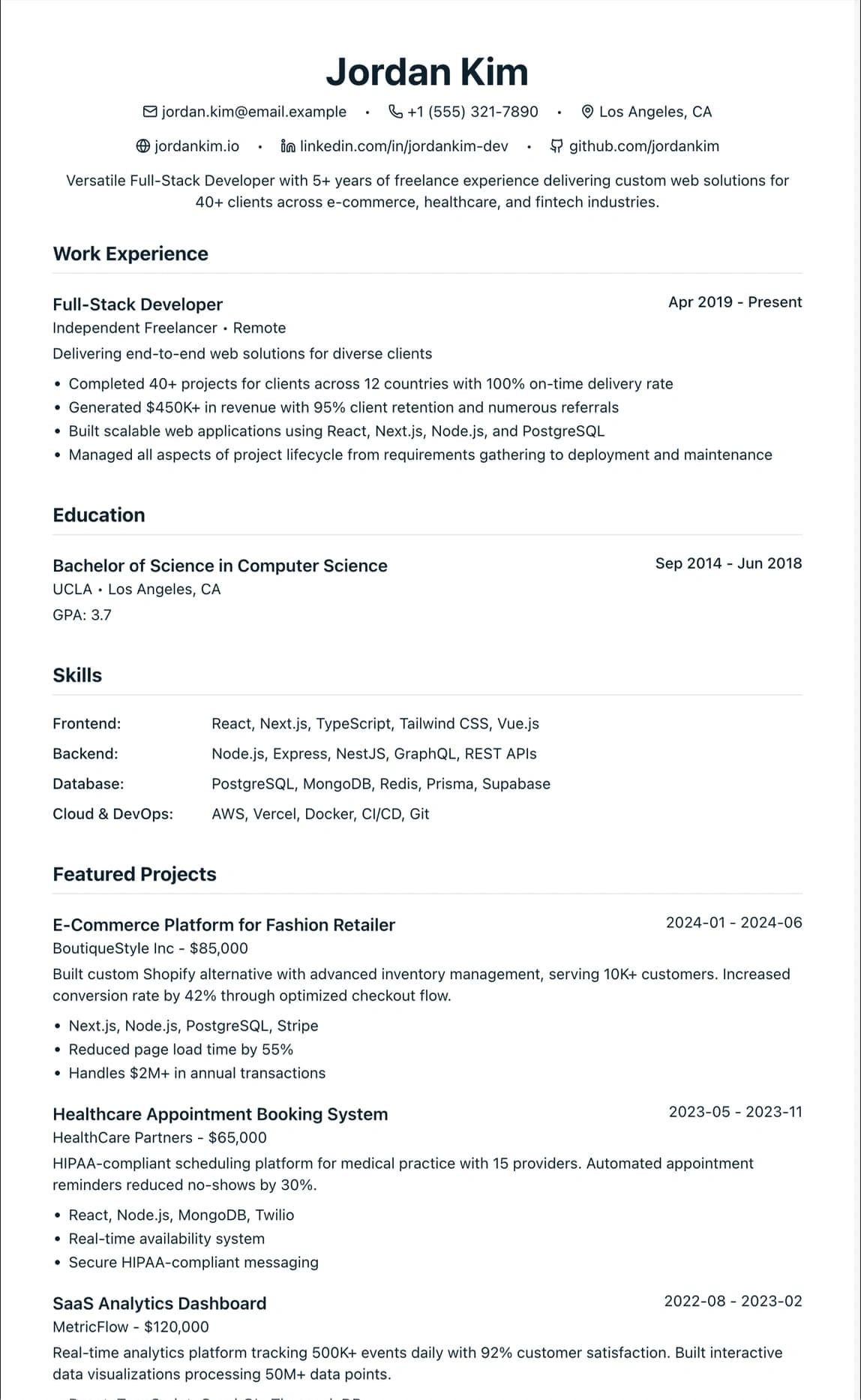
The structure that works for most freelancers is a hybrid. Standard top section (contact, headline, summary), then a single "Experience" block that groups all independent work under one title, followed by project case studies underneath. Each project is a compact, repeatable unit.
Use the same six-field block for every project:
- Client or Industry. Name the client if you are allowed and they are recognisable. If not, use sector framing: "A Series B fintech", "A UK NHS trust", "A top-10 US law firm", "A global DTC skincare brand". Sector carries weight even without a name.
- Role. Your actual contribution: "Lead designer", "Staff engineer on retainer", "Fractional head of growth". Not "Provided services".
- Duration. Month and year to month and year, or "ongoing". Exact durations signal honesty; vague phrases like "several months" signal the opposite.
- Tools. Two to five systems or stacks: "Figma, React, Vercel", "Salesforce, dbt, Looker", "Notion, Webflow, Attio". This is an ATS keyword slot as much as a content slot.
- Outcome. One quantified result. Revenue, retention, time saved, headcount, reach, error rate reduced. Numbers beat adjectives every time.
- One optional detail. A constraint, a client quote, a shipped artefact link, or the team size you worked alongside. Only when it sharpens the story.
Three to six projects is the right count. More than six dilutes; fewer than three looks thin. Rank by relevance to the role you are applying for, not by chronology. The freelancer resume is one of the few places where the strongest project can and should go first.
Handling gaps and slow periods
Freelancers often over-explain gaps and end up drawing more attention to them. The opposite works better. Name the gap, label it with a verb, and move on.
Three patterns cover most cases. Skill-building breaks like an AWS certification, a writing intensive, or a self-directed course should be labelled "Self-directed learning" with the specific skill. Strategic breaks (a health reset, elder care, parenting, a deliberate pause after a demanding engagement) read fine as "Planned break" or the specific category; most hiring managers have done one themselves. Client overlap that looks like a gap, such as two months where one client ended and the next started slowly, does not appear as a gap at all if you use ongoing-period framing ("2022 – present") rather than tight per-client start and end dates.
The honest framing matters because the alternative, stretching dates or padding with "consulting" that was really a dormant period, is visible to anyone who has read a hundred freelancer resumes, which is most experienced recruiters. Non-linear is fine. Evasive is not.
Outcome framing: metrics that matter
Outcomes are where most freelancer bullets collapse. The bullet explains what you did but not what changed. Every bullet on a freelancer resume should earn its place by answering "and then what?"
A before-and-after example, on the same project:
Before (activity-only): "Redesigned the checkout flow for a UK e-commerce client using Figma and Shopify Hydrogen."
After (outcome-framed): "Redesigned checkout flow for a UK DTC skincare brand (£12M revenue); reduced cart abandonment from 71% to 58% over six weeks, lifting monthly revenue by £180K. Figma, Shopify Hydrogen."
The second version is two sentences, not longer than the first in practice, and carries five concrete signals: client sector and size, the metric that moved, the size of the move, the time window, and the stack. The first carries none. Recruiters spend an average of 7.4 seconds on an initial resume scan, per The Ladders' eye-tracking study reported by HR Dive, so the after-version makes the cut and the before-version does not.
The metrics that travel well across freelance work: revenue moved (dollars, pounds, euros), efficiency gained (hours saved per week, lead time cut, cycle time reduced), reach or engagement (monthly active users, impressions, signup conversion), retention or reactivation (churn rate, reactivation volume), cost saved (infra spend, vendor consolidation, headcount-equivalent hours). If you have none of those, the fallback is delivery evidence: shipped products, launched campaigns, published research, with the scale attached.
Start with the Freelancer Portfolio template
Built for the project-case-study structure: six-field project blocks, clean single-column layout, and an AI bullet generator that rewrites activity lines into outcome-framed ones.
The hybrid freelancer-to-full-time pivot
A specific and under-served case: freelancers applying to permanent roles. The worry is symmetrical on both sides. You worry the hiring manager will read your resume as "not a team player". The hiring manager worries you will freelance on the side, or leave after a year. Your resume is where that worry gets resolved, or not.
Three things help.
Lead with a full-time-shaped summary. Not "Freelance designer, 12 years". Instead, "Product designer with 12 years' experience across fintech and DTC. Looking to return to an in-house role to build long-term on a single product and team." The second sentence is the quiet unlock. It tells the hiring manager you have thought about why, and the answer is not money.
Show long engagements where you have them. A nine-month retainer with one client reads very differently from a string of two-week gigs. Put the longest engagements first. If the longest is four months, that is your honest anchor; do not inflate it.
Emphasise collaboration. Freelance resumes default to "I" language. For a full-time pivot, shift to "with" language. "Paired with the marketing team to ship the Q3 campaign." "Embedded with two engineers and a PM during the discovery phase." Hiring managers need evidence you work with people, not just for them. LinkedIn's March 2025 Skills-Based Hiring report found that hiring for skills is 5x more predictive of job performance than hiring based on credentials. Freelancers with a demonstrable track record across multiple environments are the archetypal beneficiaries of that shift, if the resume surfaces it.
Rates, testimonials, and the things to leave out
An opinionated take, because the answers here move around online and most of the freelancer-resume guides hedge.
Rates: no. Day rates and project fees belong on proposals, not on resumes. A rate on a resume invites out-of-context comparison (the reader does not know your cost base, your geography, or your scope) and it anchors negotiation against you before the conversation starts. Outcomes and headline clients are better signals of seniority.
Testimonials: usually no, with one exception. A two-line quote from a recognisable client ("Director of Engineering, Revolut") can earn its place if it is specific and short. A paragraph-long quote from someone the reader has never heard of takes space away from outcomes and does not pay for itself. If you have testimonials you want to share, link them from the portfolio and use the resume space for numbers.
NDAs: sector framing. When a client contract restricts naming, use the sector and stage pattern ("A Series B fintech", "A top-10 US law firm", "A UK NHS trust") and put the metric on the outcome. Recruiters see this all the time and do not mark it against you.
Side-hustle products and open source: yes, briefly. A separate "Selected work" or "Independent projects" block under the Experience section is the right home. Two lines each, with a link and the scale ("1.2K GitHub stars", "3K monthly active users", "featured on Product Hunt").
Freelancer resume vs. portfolio vs. LinkedIn
The three artefacts do different jobs. The table below frames when each leads.
| Artefact | Primary job | Audience | Lead with | Weakest at |
|---|---|---|---|---|
| Freelancer resume | Pass initial screening and ATS filters | Recruiters, hiring managers, ATS pipelines | Quantified outcomes on 3–6 projects | Showing visual craft or long-form case studies |
| Portfolio site | Close warm leads and interested hiring managers | People already paying attention | Deep case studies, process, visuals | Passing 7-second scans or ATS parsing |
| LinkedIn profile | Inbound discovery and social proof | Recruiters cold-searching, referrers | Headline + summary + endorsements | Custom detail per role you apply for |
You need the resume for almost every inbound application and every ATS pipeline. 97.8% of Fortune 500 companies use an applicant tracking system, per Jobscan's 2025 ATS Usage Report, and a portfolio link in the header does not save a file that will not parse. Our ATS guide covers the format specifics, and SimpleCVBuilder's Minimalist ATS and Freelancer Portfolio templates are built to pass standard parsing.
How SimpleCVBuilder handles freelancer resumes
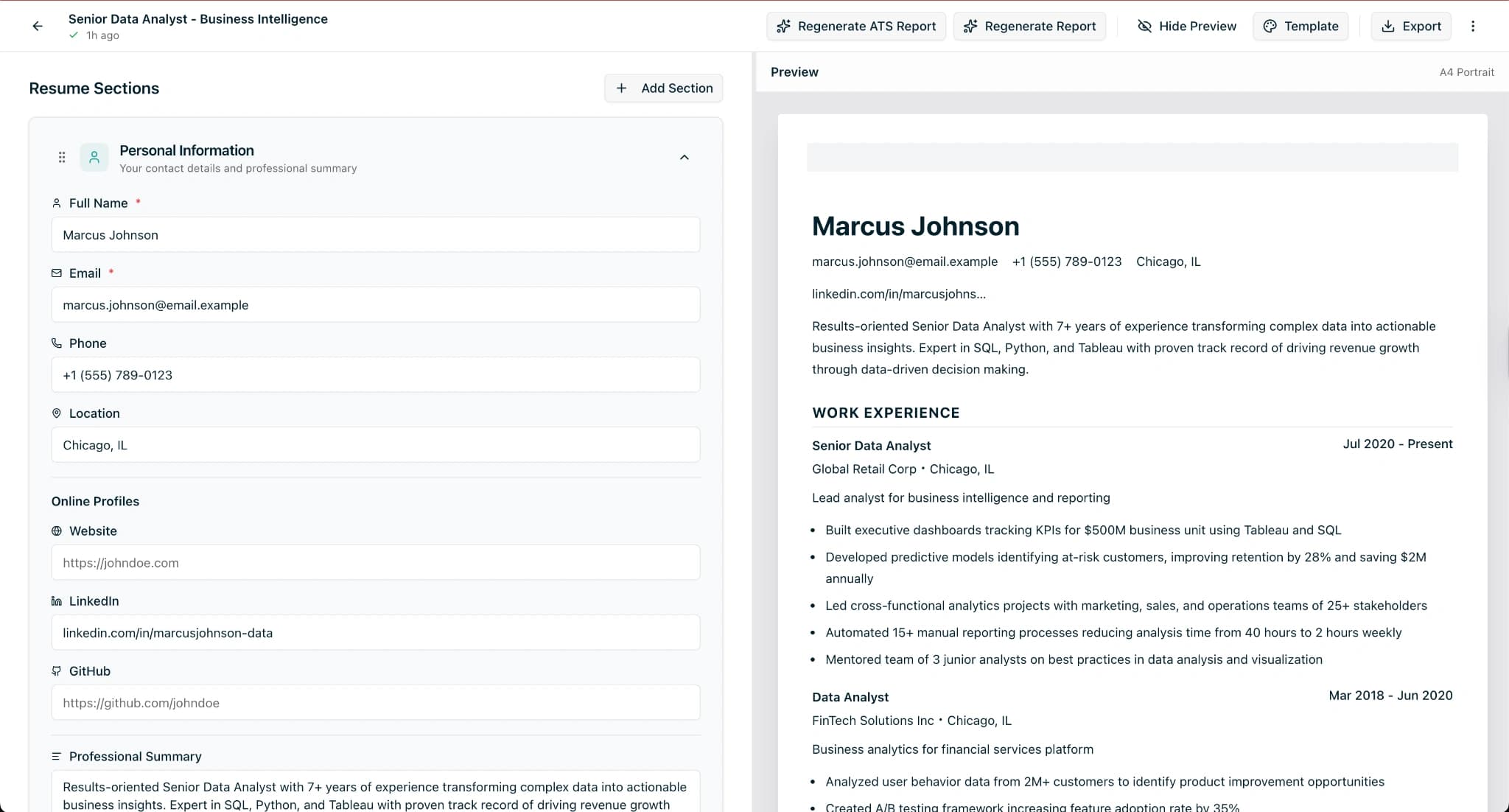
Direct, because we are not neutral. The Freelancer Portfolio template is built around the six-field project block: Client, Role, Duration, Tools, Outcome, plus an optional detail line. The free tier gives you one resume, the template, an AI ATS analyzer that scores against a pasted job description, a watermark-free PDF export, and two bullets from the AI bullet generator, which rewrites activity lines into outcome-framed ones. The Pro tier at $12.99 per month unlocks unlimited resumes, unlimited AI bullets, unlimited Career Advisor reports for freelancer-to-full-time pivots, and TXT export for pasted online forms. No credit card on the free tier. No watermark on any tier. We built this because the freelancer-resume advice everywhere else treats independent work as a liability, and we disagree. Full feature list here and the full optimizer walkthrough here.
If you are a freelancer applying to full-time roles, the career-change resume guide covers the adjacent positioning question. If you are starting from zero, the free CV builder guide and free resume builder guide cover which tools let you download a PDF without a card.
Frequently asked questions
How do I list freelance work on a resume?
List each engagement as a project case study, not as a job. Use a consistent block: Client or Industry, your Role, Duration, Tools or stack, and one Outcome with a number attached. Group engagements under a single header like "Independent Consultant" or "Freelance Product Designer" so recruiters see continuity, then let the project blocks carry the detail. Three to six strong projects beat a long list of minor ones.
Should I use a freelancer resume or a portfolio?
Both, for different jobs. The resume wins the conversation — it gets you past recruiters, ATS pipelines, and referral intros. The portfolio closes it — it shows depth to hiring managers already interested. If you only invest in one, the resume matters more for inbound applications and recruiter outreach; the portfolio matters more for direct client pitches and warm introductions.
What job title should I use as a freelancer on my resume?
Use the discipline plus "Consultant", "Contractor", or "Freelance". "Freelance Product Designer", "Independent Marketing Consultant", and "Contract Data Engineer" all parse cleanly in an ATS and signal independence without looking evasive. Avoid vague titles like "Founder" unless you genuinely ran an agency or product — recruiters read "Founder" as a business, not as a service discipline.
How do I explain gaps between client engagements on a freelancer resume?
Most gaps are either skill-building, strategic breaks, or client overlap that looks like a gap on paper. Name them honestly. A three-month block labelled "Self-directed learning, AWS certification" or "Research break, rewriting practice focus" reads as directed work, not absence. Do not apologise, do not use padding language, and do not pretend continuity where there was none.
Should I include client names on my freelancer resume?
Name clients when you are allowed to and when the client is recognisable. If you worked with a household-name company, naming them lifts your credibility more than any outcome bullet. If you have NDAs or the client is small, use sector framing instead — "A Series B fintech", "A UK NHS trust", "A top-10 US law firm". Either way, the outcome matters more than the logo.
How do I include rates or day rates on a freelancer resume?
Do not put rates on the resume. Rates belong on proposals and in conversations where you can frame them against scope. A rate on a resume invites out-of-context comparison and can anchor negotiation against you. Outcomes and headline client names are better signals of seniority.
How do I pivot from freelancing back to a full-time role?
Position the freelance period as directed experience with a coherent through-line. Lead the summary with a single sentence framing what you do, then show three to five projects whose outcomes map to the full-time role you want. Emphasise collaboration, handover, and long-engagement projects over one-off gigs — hiring managers worry about whether freelancers can commit to a team, so evidence that you can is the quiet unlock.
Does freelance work count as real experience on a resume?
Yes. US knowledge freelancers earned roughly $1.5 trillion in 2024 per Upwork's Future Workforce Index, and full-time US independents passed 27.7 million in 2024 per MBO Partners. Recruiters who still treat freelance work as "not real experience" are a shrinking minority and usually self-select out of the search — most modern hiring managers read a well-structured freelance track as evidence of range, initiative, and ownership.