TL;DR. A career change resume is written for a job you have not done yet. The reader does not need a chronological record of your old industry. They need evidence that your skills transfer, that you understand the new role's language, and that hiring you is a low-risk decision. The 4-step pivot framework: decode the target role, map transferable skills into the new industry's vocabulary, reframe experience so each bullet leads with an outcome, and bridge with a targeted summary and cover letter. Use a hybrid format, not a pure functional one. Examples below cover teacher-to-tech, military-to-corporate, academia-to-industry, and finance-to-product pivots.
Last updated: April 2026.
If you are reading this, you have already decided the pivot is happening. What you need now is a document that makes someone in the new industry look at your old industry and think, "this person already does what we need." That is a writing job, not a career-history job.
Career change is no longer a niche scenario. US median employee tenure fell to 3.9 years in January 2024, per the Bureau of Labor Statistics: the lowest since 2002. Deloitte's 2025 Global Human Capital Trends survey of nearly 10,000 leaders found 73% of executives and 72% of workers agreed organizations should do more to help workforces build hands-on experience across roles. The hiring manager on the other side of your application has almost certainly changed careers themselves. That is new, and it matters.
Why career-change resumes fail
Three patterns show up in almost every failed pivot resume.
Chronological-only. You open with your most recent role, write the same bullets as always, and hope the reader connects the dots. They will not. Recruiters spend an average of 7.4 seconds on the initial resume scan, per The Ladders' eye-tracking study reported by HR Dive. They cannot connect dots in 7.4 seconds. You have to draw the line for them.
Skill-laundry-list. Thirty transferable skills at the top ("leadership, communication, problem-solving, stakeholder management") with no evidence, no numbers, no tie to a real outcome. Aspirational rather than credible. Recruiters skip it.
Pure functional format. Strip the dates, group everything under "Skills," hope the reader does not notice the titles do not match. In 2026 this is a red flag. Functional resumes are associated so heavily with hiding something that most recruiters discount them on sight. Use a hybrid format instead: skills-led at the top, reverse-chronological underneath.
The 4-step career-pivot framework
This is the core of the method. Run every section of your resume through it.
1. Decode the target role
Pull three real job descriptions for the role you want. Not one: three. Strip the fluff and the legal boilerplate. What remains is a list of skills (what you need to be able to do) and outcomes (what the company needs you to deliver). Write them in two columns.
Patterns appear immediately. A product manager role asks for "stakeholder alignment," "roadmap prioritization," and "data-informed decision making." A project manager role asks for "cross-functional delivery," "risk management," "scope control." Exact phrasing matters. Jobscan's 2025 research found 99.7% of recruiters use keyword filters inside their ATS. You are writing for two audiences: a human who skims in seven seconds, and a machine that matches exact and near-exact phrases.
2. Map your transferable skills
With the target role decoded, go back through your own experience and find the equivalents. This is translation, not invention. Every real role produces transferable skills; the trick is naming them in the target industry's vocabulary.
A teacher "managed classroom behavior." In product-management language, that is "stakeholder management with 30 distinct stakeholders, daily." An account executive "ran quarterly business reviews." In customer success language, that is "drove retention across a $2M book through structured engagement cadence." A military officer "led a 40-person platoon." In corporate leadership language, that is "directed cross-functional team of 40 through operational deployment under ambiguous conditions, achieving mission outcomes on compressed timelines."
None of those rewrites invent anything. They rename. The underlying work is real; the label is new.
LinkedIn's March 2025 Skills-Based Hiring report found hiring for skills is 5x more predictive of job performance than hiring based on educational credentials. 57% of senior leaders now value soft skills over hard skills, per LinkedIn's 2025 Workplace Learning Report. The market is moving in your direction, but only if you speak its language.
3. Reframe your experience
Once you have the vocabulary, rewrite every bullet so it leads with an outcome rather than a title or a task. "Led" is weak; "Led X team through Y to deliver Z outcome in W timeframe" is strong. The structure is: action verb + scope + method + measurable outcome.
Before (teacher): Taught Year 9 science to mixed-ability classes. After (project manager pivot): Led weekly curriculum delivery for 120 stakeholders across three cohorts, adapting content in real time based on performance data and raising passing-grade rate from 71% to 84% over one academic year.
Before (military): Platoon leader, 2nd Battalion. After (operations manager pivot): Directed 40-person operational team through six-month deployment, coordinating logistics, safety, and stakeholder reporting for a $12M asset portfolio with zero injury incidents.
The content is identical. The framing is different.
4. Bridge with a summary and cover letter
The summary at the top of the resume is your pivot thesis statement. Three to four lines. It says: who you are now, what you can already do, and what you want next. The cover letter is where the narrative lives: the "why this pivot, why now, why this company" in 250 to 350 words.
Do not try to fit the narrative on the resume. Resumes are not stories. They are evidence documents. The story goes in the cover letter; the evidence goes on the resume.
Format choice: functional vs. hybrid vs. chronological
Choose the format based on what you need to foreground, not on what your old industry used.
| Format | How it looks | Best for | Honest downsides |
|---|---|---|---|
| Chronological | Reverse-date work history first, skills second | Linear career paths, internal promotions, same-industry moves | Buries transferable skills; forces recruiter to translate for you |
| Functional | Skills-led, grouped by competency; dates de-emphasized | Almost nothing in 2026 | Reads as hiding a gap or inflating scope; actively harms credibility |
| Hybrid (combination) | Skills-led summary + core competencies at top, reverse-chronological work history underneath | Career pivots, returning-to-workforce scenarios, freelance-to-FTE | Requires more writing discipline; you have to earn the skills section |
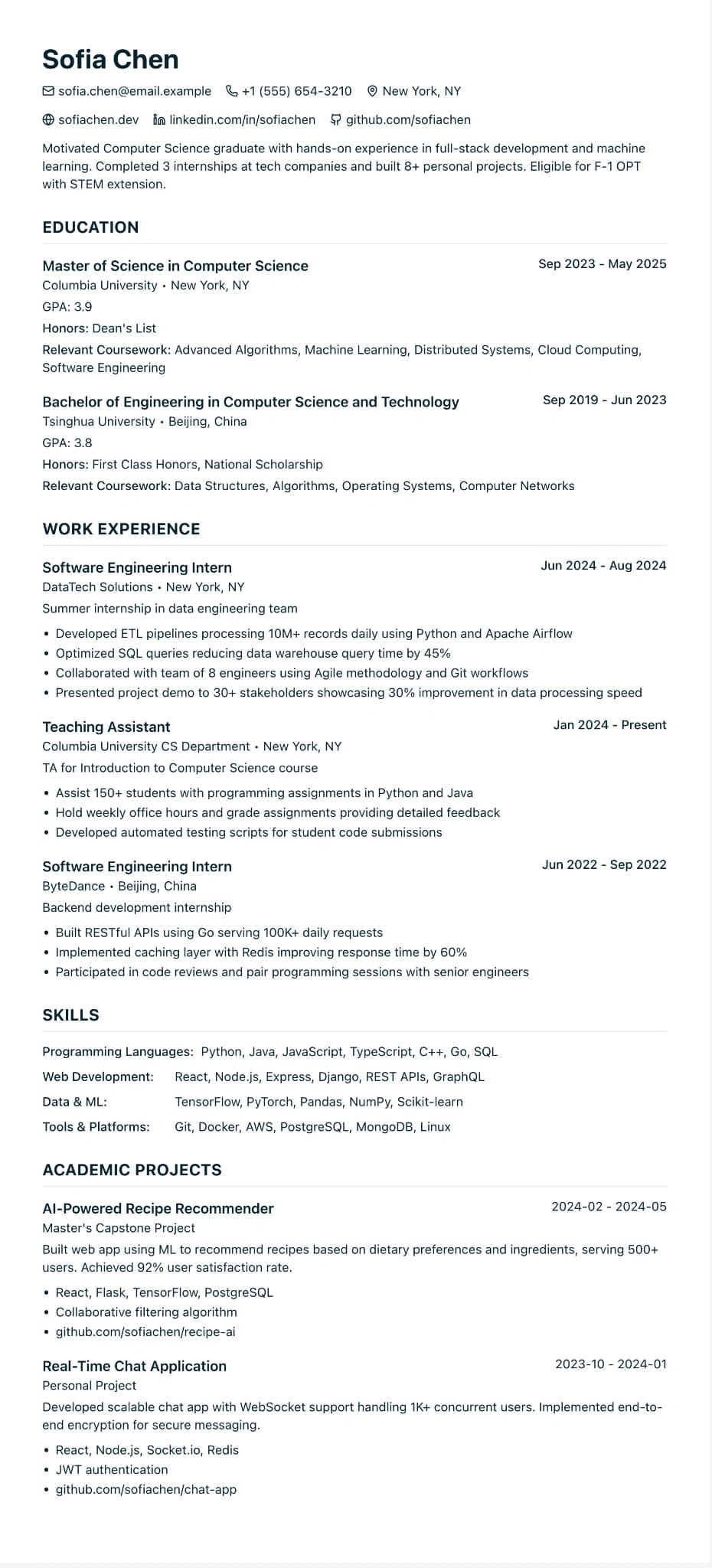
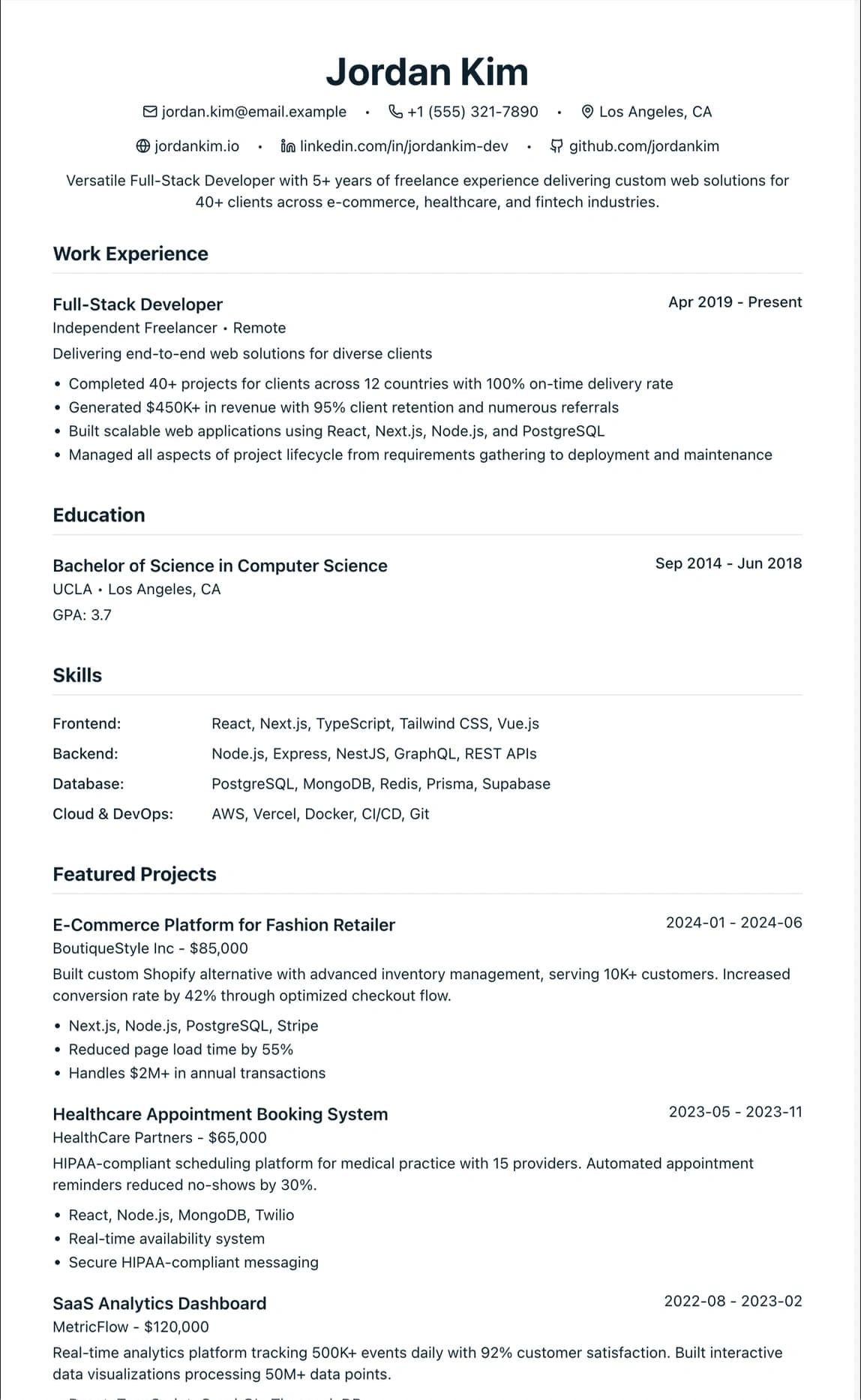
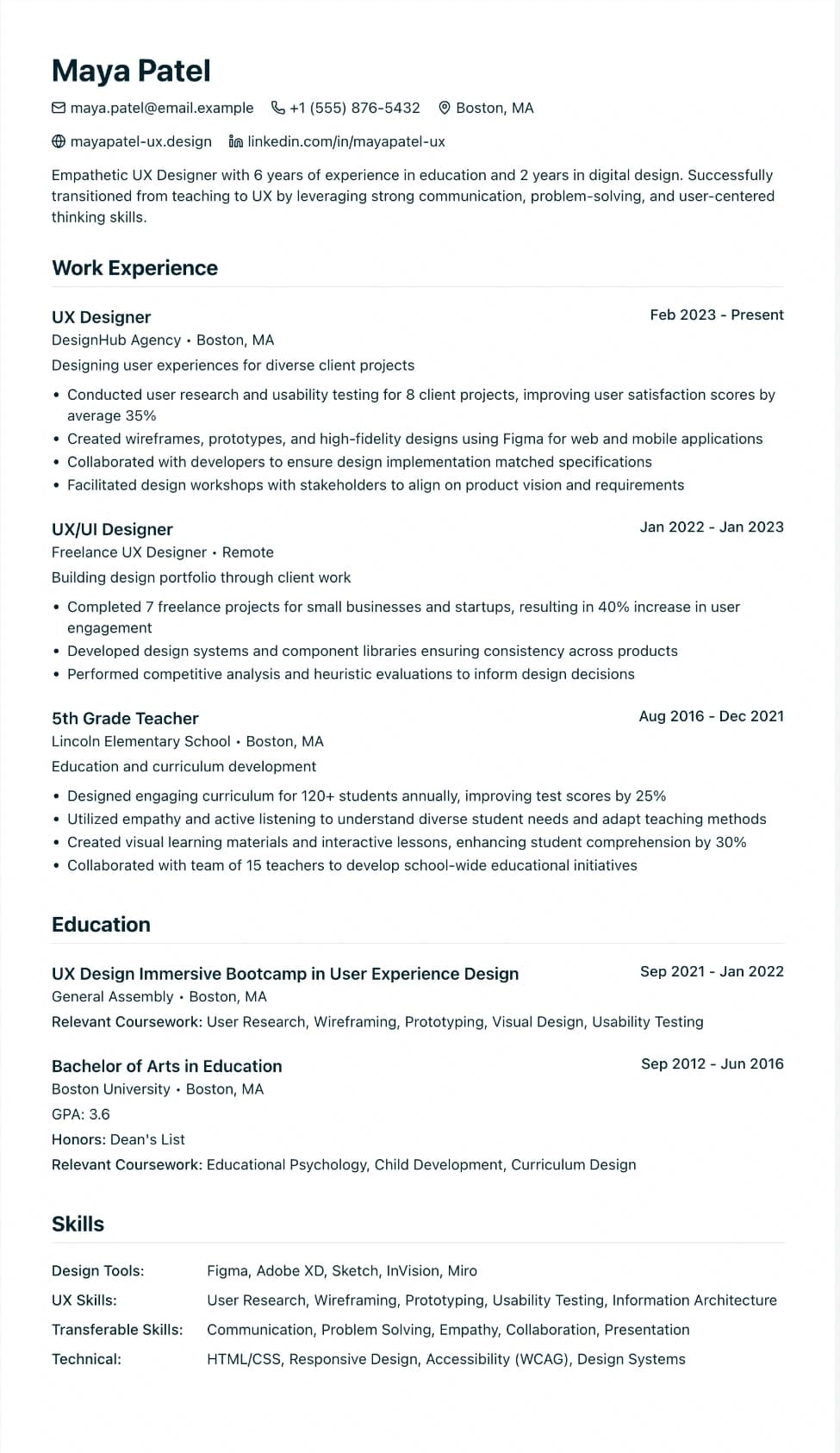
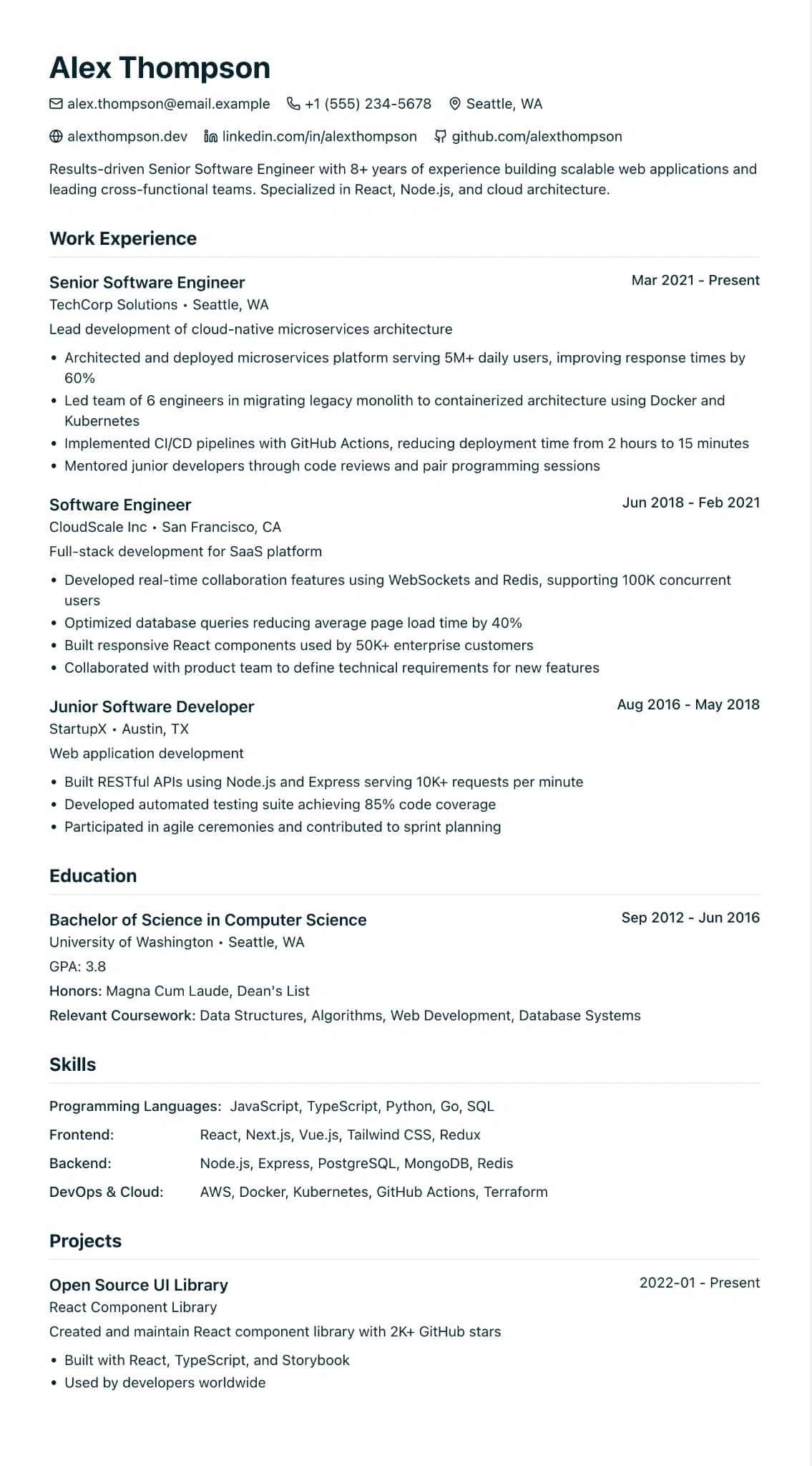
The hybrid resume is almost always the right call for a pivot. It gives the recruiter a 7-second path to your transferable value at the top, then backs it up with the chronological proof underneath. Our Career Changer template is built specifically for this structure: a skills-led header, a targeted summary, and a reverse-chronological history where every bullet is pre-framed for outcome-first writing.
Use the Career Changer template — built for pivots
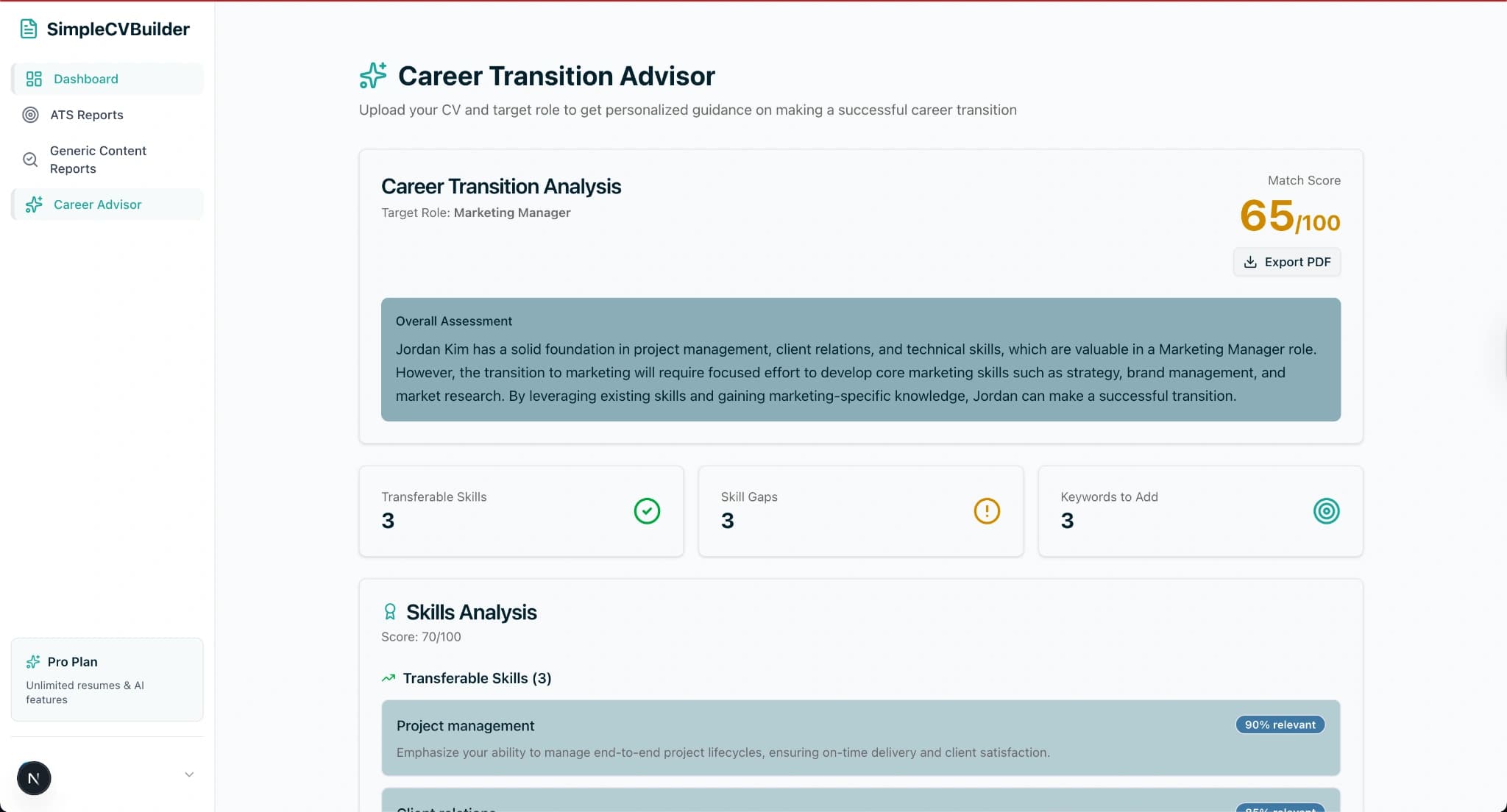
A hybrid-format resume template designed for career pivots, paired with the Career Advisor AI, which shows which of your skills transfer to the target role.
Transferable skills examples across common pivots
Four pivot patterns covering most real career changes. Each example shows the translation pattern, not the finished bullet, but how to think about the rewrite.
Teacher to tech (product, design, UX research, customer education). Classroom management maps to stakeholder management. Lesson planning maps to product requirements and user-journey mapping. Differentiated instruction maps to user-segment thinking. Grading rubrics map to evaluation frameworks. Teachers are almost always better product thinkers than they realize.
Military to corporate (operations, project management, consulting). Platoon leadership maps to cross-functional team leadership under ambiguity. Mission planning maps to project scoping and risk management. Post-action reviews map to retrospectives and continuous improvement. Standard operating procedures map to process documentation. Military resumes fail when they keep the military vocabulary; they win when they translate to civilian equivalents while retaining the scale.
Academia to industry (research, data science, strategy, product). Grant writing maps to business-case development. Peer review maps to stakeholder feedback loops. Literature review maps to competitive analysis. Teaching assistantships map to mentorship and onboarding. McKinsey's 2024 research found 91% of workers now use generative AI at work, and PhD candidates often have an edge here because rigorous research methods translate directly to AI-era data interpretation roles.
Finance to product (fintech PM, strategy, operations). Financial modeling maps to business-case sizing. Client coverage maps to stakeholder management. Deal execution maps to end-to-end project delivery. Risk frameworks map to product trade-off analysis. The pivot narrative writes itself: "I already make business-impact calls under constraint, and now I want to do it for the thing being built, not just the transaction."
The targeted summary statement
The summary is the hardest three lines you will write. Below are three before/after pairs.
Before (vague objective). Motivated professional seeking new opportunities to leverage skills and experience in a challenging environment. After (targeted pivot). Education-sector product manager with eight years of curriculum-design experience and a track record of raising student outcomes by 18% across 1,200 learners. Pivoting to edtech product management to combine classroom insight with software delivery.
Before (leaning on old industry). Experienced middle-school science teacher with strong communication skills. After (leaning on target industry). Curriculum-design specialist with 120-stakeholder weekly delivery cadence, data-driven iteration experience, and measurable performance improvement. Targeting product manager roles in learning-software companies.
Before (self-focused). Seeking a career transition into technology where I can grow and develop new skills. After (reader-focused). Military officer translating six years of cross-functional team leadership and operational logistics into a technical project management role at a $100M+ engineering organization. PMP-certified, scaled team experience with 40+ direct reports.
Each "after" version tells the reader three things in three lines: what you already are, what you can prove, and what you want next. That is all a summary needs to do.
Your 2-week career-change resume plan
A realistic timeline. Most people try to do this in a weekend and produce something generic. Two weeks, one hour a day, produces a resume that actually opens doors.
Days 1–2: Target decoding. Pull three real job ads for the role you want. Extract skills and outcomes into two columns. Identify the five most-repeated skills and the three most-repeated outcomes. This is your target specification.
Days 3–4: Skills mapping. Go through every role on your current resume and identify which target skills each role produced evidence of. Write a short note next to each job: "This role shows stakeholder management at scale and data-informed prioritization." Do not rewrite yet — just map.
Days 5–7: Bullet rewriting. Rewrite every bullet using the action-verb + scope + method + outcome structure, leading with a target-industry verb where possible. Keep the facts; change the vocabulary. The AI bullet generator helps with the bullets where you cannot find the right word.
Days 8–9: Summary and layout. Write your targeted summary using the three-line structure above. Move into a hybrid template. The Career Changer template is built for this. Check the ordering: skills section near the top, reverse-chronological work history underneath.
Days 10–11: ATS check. Run the resume through SimpleCVBuilder's AI Resume Optimizer against one of the three target job descriptions. Aim for 75+ on keyword coverage. Adjust the vocabulary, not the underlying experience, if you are below. See our ATS guide for the manual checklist.
Days 12–13: Cover letter. Write one master cover letter that tells the pivot story: why this pivot, why now, why this kind of company. This is the narrative layer the resume cannot carry.
Day 14: Tailor and send. For each application, adjust the summary and top five bullets to match the exact job ad. Everything else stays stable. Apply.
Where SimpleCVBuilder fits
The Career Advisor AI and the Career Changer template are the two pivot-specific tools. Free accounts get one Career Advisor report; Pro at $12.99 per month gives you unlimited reports and the template. The Career Advisor compares your CV with a target role, and a job description if you add one, and tells you which skills transfer and which need more evidence. The Career Changer template is the hybrid-format layout that puts that evidence first. Neither invents experience; they work from what is already on your CV.
Career change is not a sign that something went wrong. It is how careers work now. And if you have been quietly worried that you are not "qualified enough" for the pivot, notice what that worry really is: a vocabulary gap, not a capability gap. Gartner's October 2025 analysis notes 61% of HR leaders are in advanced-stage generative-AI deployment, and 82% plan to deploy agentic AI within 12 months. The hiring systems are getting better at semantic skill matching, which is a direct advantage for career changers, provided the resume is written in the right language.
For the builder side of this, see our guides on the free CV builder landscape, the free resume builder market, the ATS-friendly resume checklist, and the freelancer resume guide if your pivot involves contract work.
Frequently asked questions
What is the best resume format for a career change?
A hybrid resume — also called a combination resume — is almost always the right format for a career changer. It opens with a skills-led summary and a prominent skills section, then follows with a reverse-chronological work history. Pure functional resumes are a red flag to recruiters in 2026 because they look like they are hiding a gap. Reverse-chronological alone buries the transferable-skill evidence that makes a pivot credible.
How do I write a career change resume summary?
Lead with what you want to do, not what you have done. A strong summary is three to four lines: your target role framed as an identity, two to three transferable strengths tied to that role, and one concrete outcome from your previous career rendered in the new industry's vocabulary. Skip objective statements that only describe your desire for the role — they add no signal.
Should I include all my old work experience on a career change resume?
Yes, in most cases. Hiding a ten-year career creates a larger gap than it fixes, and recruiters will find the history on LinkedIn anyway. The better move is to keep the roles but rewrite the bullets so each one leads with a transferable outcome rather than an industry-specific task. Cut entry-level jobs from 15 years ago that do not support the pivot story.
How do I highlight transferable skills on a resume?
Decode the target role first — pull five to seven skills and three to five outcomes directly from three real job descriptions. Then rewrite your existing bullets so the skill the target role wants appears as the verb of the sentence. A teacher moving into project management writes "Led 32-person cross-functional rollout of new curriculum, delivering on time and under budget" rather than "Taught science to Year 9."
Do recruiters care about career changers in 2026?
More than they used to. LinkedIn's March 2025 Skills-Based Hiring report found hiring for skills is five times more predictive of job performance than hiring based on credentials, and 85% of employers report using skills-based hiring in some form. BLS data shows US median tenure is now 3.9 years — a 22-year low — so most hiring managers have changed careers themselves or hired someone who did. The stigma is measurably smaller.
Should I mention why I am changing careers on my resume?
Briefly, in the summary, and only if the reason is forward-looking. A single line like "pivoting from clinical nursing to health-tech product management to combine patient-care insight with software delivery" signals intent and direction. Skip personal reasons on the resume — "seeking a better work-life balance" is a cover-letter line, not a resume line.
How long should a career change resume be?
One page if you have under ten years of experience, two pages if you have more. Do not pad a short pivot resume with irrelevant history, and do not cut a senior career down to one page if it removes evidence of leadership that transfers. The length rule that matters: every line should earn its place in the pivot story.
Can AI help me write a career change resume?
Yes, for the mechanical parts — parsing job descriptions, identifying missing keywords, and rewriting bullets in a new industry's vocabulary. AI should not invent experience or fake outcomes. SimpleCVBuilder's Career Advisor AI shows which of your skills transfer to a target role, and Tailor to a job rewrites your summary, bullets and skills against a job ad without adding anything your CV does not support.